

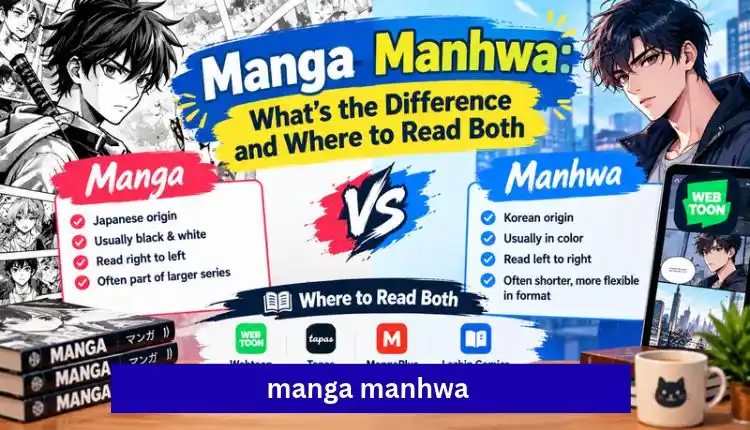
This page covers “manga manhwa” in plain terms.
Manga is Japanese comics, usually black and white and read right to left. Manhwa is Korean comics, usually full color and built for scrolling on a phone. That one difference shapes how each is made, drawn and read. This guide explains what separates them, where each one shines, and how to start reading either without getting lost in the terminology.
What Is Manga?
Manga refers to comics and graphic novels created in Japan, going back decades before webtoons existed. Osamu Tezuka is often credited as the father of modern manga, and the medium has since split into dozens of demographic categories: shonen (aimed at young boys), shojo (young girls), seinen (men), and josei (women), among others, Visit more.
A few things define manga as a format:
- Black and white artwork, with color reserved for cover pages or special chapters
- Right-to-left reading direction, a holdover from traditional Japanese text layout
- Printed volume (tankobon) releases, though most series now run digitally as well
- Dense, detailed linework, especially in action and fantasy titles
Manga is also where most people encounter the word “raw” for the first time, referring to untranslated, original-language chapters released in Japan before official translations catch up. If you’re curious about how raw scans work and where fans source them responsibly, our raw manga guide covers the terminology and reading process in more detail.
What Is Manhwa?
Manhwa is the Korean equivalent, though “equivalent” undersells how different the reading experience actually is. Korean comics grew up alongside smartphones rather than print runs, and that history shows in the format itself.
Key traits of manhwa:
- Full color artwork as the default, not the exception
- Vertical scroll format, built for swiping down on a phone screen rather than flipping pages
- Left-to-right reading order, matching how most non-Japanese readers already read text
- Webtoon-native publishing, with platforms like Naver Webtoon and Kakao Page driving the industry
Manhwa has become the fastest-growing segment of the online comics world, largely on the back of genres like isekai fantasy, revenge thrillers, and romance. Titles such as Solo Leveling and Tower of God introduced a huge number of Western readers to the format, and the pipeline from webtoon to anime adaptation has only accelerated that growth.
Manga vs Manhwa: Key Differences
| Feature | Manga | Manhwa |
| Country of origin | Japan | South Korea |
| Reading direction | Right to left | Left to right |
| Color | Mostly black and white | Mostly full color |
| Format | Print volumes, panel-based pages | Vertical scroll, webtoon-style |
| Typical device | Book or e-reader | Smartphone |
| Popular genres | Shonen action, seinen drama, romance | Isekai fantasy, revenge, romance |
| Industry term for untranslated releases | Raw manga | Raw manhwa / raws |
| Raw manhwa / raws | Common platforms | Shonen Jump, print publishers |
The table covers the basics, but the differences run deeper once you start reading regularly. Manga panels are built for the eye to move around a page, sometimes non-linearly, with paneling used for dramatic pacing. Manhwa panels are stacked so your thumb does the pacing, scrolling at whatever speed the story wants you to feel. Neither approach is better. They’re just built for different habits.
Reading Direction and Art Style
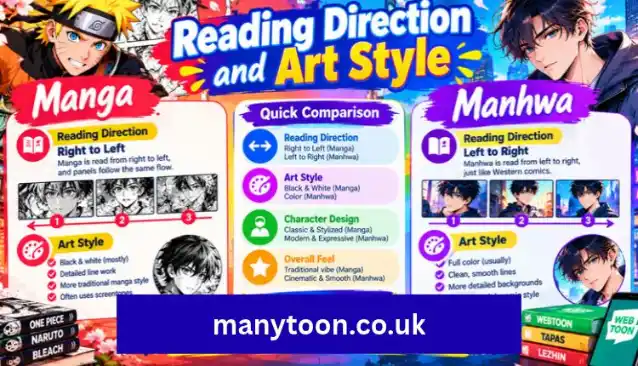
New readers usually trip over reading direction before anything else. Pick up a manga volume and you start from what looks like the back cover, moving right to left, top to bottom within each page. It takes maybe two chapters to adjust, and most digital readers now include a toggle if the flow feels backwards.
Manhwa skips that adjustment entirely. Since it’s read top to bottom on a single continuous scroll, there’s no panel order to memorize. This is part of why manhwa is often recommended as the easier entry point for readers coming from Western comics or graphic novels, since Western-style cartoon comics already use a similar left-to-right, single-direction flow.
Art style differs too. Manga leans on screentones, crosshatching, and speed lines to convey motion and mood without color. Manhwa artists, working in full color from the start, tend to use lighting, gradients, and painterly backgrounds to build atmosphere instead. Neither is more “advanced.” They’re just different tools for the same job.
Popular Genres Across Manga and Manhwa
Genre overlap between the two is bigger than most readers expect, but each medium has areas where it dominates.
Manga strengths: shonen battle series, slice-of-life drama, horror, and long-running seinen titles with decades of continuity. If you want a story that unfolds slowly across hundreds of chapters with deep worldbuilding, manga usually delivers it.
Manhwa strengths: isekai and system-based fantasy, modern romance, and revenge or redemption arcs with a strong single protagonist. The scroll format suits fast-paced action and cliffhanger endings, which is part of why so many manhwa chapters end on a punch or a reveal.
Some genres, like sports drama or supernatural mystery, show up strongly in both, just with different pacing and visual approaches.
Where to Read Manga and Manhwa Online
Official platforms are the safest and most reader-friendly starting point. Naver Webtoon and Kakao Page cover most licensed manhwa, while Viz Media and Shonen Jump handle a large share of licensed manga. Many series are also available through library apps, which is worth checking if you’d rather not pay per title.
If you’re looking for a broader spread of comics beyond the two headline categories, our full comics hub rounds up different formats in one place, and our roundup of manhwa reading sites breaks down where different genres and age ratings are best covered.
A quick note on unofficial scan and translation sites: they’re common, but they don’t pay the original creators. If a series you love is available legally, reading it through the official release supports the studios and writers actually making it.
Manga Manhwa Recommendations for Beginners
If you’re not sure where to start, a short mixed list usually works better than committing to one format right away:
- One Piece (manga), long-running shonen adventure with an enormous cast
- Solo Leveling (manhwa), the series most credited with mainstreaming webtoons in the West
- Chainsaw Man (manga), fast, violent, and modern seinen storytelling
- Tower of God (manhwa), layered worldbuilding with a slow-burn mystery
- Spy x Family (manga), family comedy with action, easy to recommend to almost anyone
Reading one of each is usually enough to know which format fits your habits better. Some readers end up loving both equally, depending on the story rather than the medium.
Conclusion
Manga and manhwa both tell great stories, they just come from different countries, different reading habits, and different production pipelines. Manga gives you decades of print history, distinctive black-and-white art, and a right-to-left reading style that becomes second nature after a chapter or two.
Manhwa gives you full color, scroll-based pacing, and a faster path from webtoon to global hit. Try both, see which one your reading habits actually match, and don’t be surprised if you end up with a shelf, or a bookmark folder, full of each.
For general background, see the Wikipedia overview of manhwa.
FAQs About Manga and Manhwa
Is manhwa the same as manga?
No. Manga is from Japan and manhwa is from South Korea. They share a comic book format but differ in color, reading direction, and typical publishing platforms.
Which is better, manga or manhwa?
Neither is objectively better. Manga tends to suit readers who want detailed black-and-white artwork and print-style pacing, while manhwa suits readers who prefer full color and a scrolling, phone-first format.
Why is manga read right to left?
It follows traditional Japanese text layout, which reads top to bottom and right to left. Publishers kept this format for international releases to preserve the original artwork and paneling.
What does “raw” mean in manga and manhwa?
A raw is the original, untranslated chapter released in its home language before an official translation is published. Our raw manga breakdown explains how raws typically reach readers and the terminology around them.
Is manhwa always in color?
Almost always, since it’s built for webtoon platforms that display comics as a color scroll. Some older or print-adjacent manhwa still use black and white, but it’s no longer the norm.
Can beginners jump straight into manhwa without reading manga first?
Yes. There’s no required order. Manhwa’s left-to-right, scroll-based format is often easier for readers who are new to the wider comics genre, including manhwa manga crossover terminology that trips up newcomers.
