

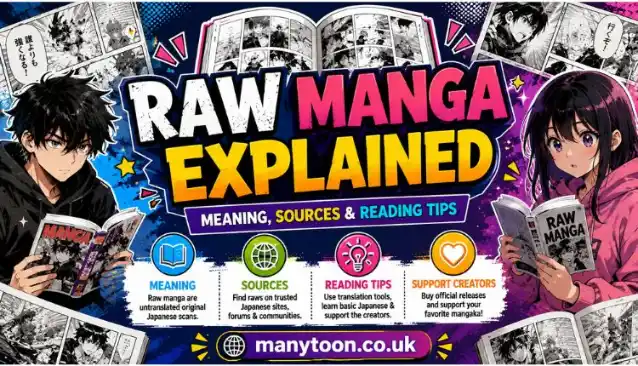
If you’ve spent any time in manga forums or Discord servers, you’ve probably seen someone ask for the “raw” before a chapter has even been translated. That’s raw manga: the original Japanese pages, straight from the source, before anyone has touched them with a translation or an edit.
It sounds simple, but the term gets thrown around loosely, and a lot of readers mix it up with scanlations or bootleg scans. Here’s what raw manga actually is, why people go looking for it, and what to keep in mind before you dive in.
What Is Raw Manga?
Raw manga refers to manga chapters or volumes in their original, untranslated Japanese form. No subtitles, no fan translations, no cleaned-up text bubbles. Just the artist’s original work, exactly as it was published in Japan.
For most international readers, raw manga is a stepping stone rather than a destination. Some use it to read chapters early, since raws often surface before official translations catch up. Others use it to practice reading Japanese, treating each chapter like a language exercise wrapped around a story they already love.
It’s worth separating this from a scanlation, which is a raw chapter that a fan translator has already worked on. Scanlations add translated text, sound effect edits, and sometimes redrawn panels. Raw manga skips all of that. It’s the unfiltered source material.
Raw Manga vs Scanlations vs Official Translations
The table below breaks down how these three formats actually compare for a typical reader.
| Aspect | Raw Manga | Scanlation | Official Translation |
| Language | Original Japanese, no edits | Fan-translated, quality varies | Professionally translated and edited |
| Speed | Available fastest, often same day as Japanese release | Usually a few days to weeks behind the raw | Weeks to months behind, sometimes longer |
| Legal status | Depends entirely on the source | Generally unauthorized, a legal gray area at best | Fully licensed and paid for |
| Accuracy | Preserves the artist’s original intent completely | Depends on the translator’s skill and interpretation | Edited and quality-checked, though localization choices vary |
| Best suited for | Japanese learners, day-one readers, purists | Casual fans who want speed without waiting for official releases | Readers who want a polished, dependable reading experience |
None of these formats is objectively “better.” It really comes down to what you’re optimizing for: speed, language practice, or a reliable reading experience you don’t have to think twice about.
Why Readers Go Looking for Raw Manga
A few reasons come up again and again:
- Speed: Raws typically appear before any translated version, sometimes within hours of a chapter dropping in Japan.
- Language learning: Reading a story you already care about is a genuinely good way to build vocabulary and get comfortable with sentence structure, far more engaging than a textbook drill.
- Unfiltered art and tone: Some jokes, wordplay, and cultural references just don’t survive translation. Reading the raw version means experiencing the story the way the creator actually wrote it.
- Avoiding delays on niche titles: Smaller or older series sometimes never get an official translation at all, so the raw is the only way to keep up.
That said, raw manga isn’t for everyone. If you don’t read Japanese, a raw chapter is just a series of pictures with text you can’t parse. It works best for readers who are either already learning the language or are comfortable piecing together the story from art alone.
Where Manga and Manhwa Fans Actually Read

Manga and its Korean cousin, manhwa, often get lumped together, but the “raw” concept applies a bit differently to each. Manhwa raw usually refers to the original Korean-language chapters before they’ve been localized for English-speaking audiences, and the demand for it works the same way: readers want the story before the translation catches up.
If you’re browsing for legitimate places to read comics, platforms that host a wide range of webtoons and manga are usually a safer starting point than random raw-scan sites, since they tend to have clearer content policies and more consistent uptime. For readers who are newer to the genre, it’s worth reading through a broader overview of how digital comic platforms work before hunting for raws specifically, since it helps set expectations for what’s officially licensed versus what isn’t.
Is Reading Raw Manga Legal?
This is where it gets murky, and I won’t pretend there’s a clean answer. A raw scan posted by the publisher itself, or made available through an official Japanese platform, is legitimate. A raw scan uploaded to a random aggregator site without permission is not, even if no one is translating or profiting from it directly.
I’m not a lawyer, and copyright enforcement varies a lot by country and by publisher. What I can say is that the manga industry runs on sales, and raws that circulate outside official channels cut into the revenue that funds the next volume. If you want to support the creators whose work you’re reading, official apps and licensed platforms are the more sustainable option, even if they’re a step slower.
Tips for Reading Raw Manga as a Learner
If you’re using raw manga to practice Japanese, a few things make the process a lot less frustrating:
- Start with something you’ve already read in translation: Knowing the plot means you can focus on parsing sentences instead of guessing what’s happening.
- Keep a dictionary app open: Tools that let you look up kanji by drawing or by radical are far faster than typing when you don’t know how to read a word yet.
- Don’t try to translate every line: Get comfortable with skimming for meaning first, then go back for the details that matter.
- Pick genres with simpler dialogue: Slice-of-life and shorter comedy series tend to use more everyday language than dense fantasy or historical titles.
- Be patient with yourself: Reading raw manga fluently takes months of consistent practice, not a weekend.
For general background, see the Wikipedia overview of manga.
FAQs
What does “raw” mean in manga?
“Raw” refers to the original, untranslated version of a manga chapter or volume, exactly as it was published in Japanese before any fan or official translation.
Is raw manga the same as a scanlation?
No. A scanlation is a raw chapter that has already been translated and edited by fans. Raw manga has no translation at all.
Can I read raw manga if I don’t speak Japanese?
You can look at the art, but you’ll miss the dialogue and most of the story. Raw manga is mainly useful for readers who are learning Japanese or already read it fluently.
Is downloading raw manga legal?
It depends entirely on the source. Raws distributed by the publisher or an official platform are legal. Raws uploaded without permission to unofficial sites generally are not, even though enforcement varies widely.
Why do raw chapters come out before translated ones?
Raws only need to be scanned or photographed and uploaded, while translations require someone to read, translate, edit, and typeset the text, which takes considerably more time.
Is reading raw manga a good way to learn Japanese?
It can be, especially if you already know the story and are motivated to reread it in the original language. It works best alongside actual language study rather than as a replacement for it.
Conclusion
Raw manga fills a specific niche: readers who want a story the moment it’s published, or who are using it as a real-world language exercise. It’s not a shortcut for everyone, and it comes with legal and ethical questions that are worth taking seriously rather than brushing aside.
If speed and language practice matter more to you than a fully polished reading experience, raw manga is worth exploring. If you’d rather support the creators and read something built for accessibility, sticking with official translations and licensed platforms is still the more dependable path. Either way, knowing the difference between a raw, a scanlation, and an official release means you can make that choice with your eyes open.
