

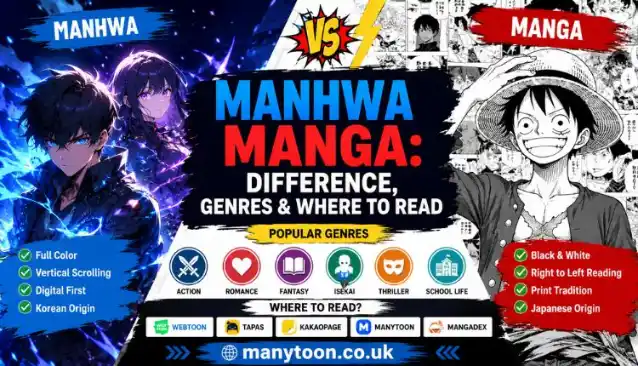
Manhwa manga is a search phrase readers use for East Asian comics in general. Manga is Japan’s comic tradition and manhwa is Korea’s. This guide shows how to tell them apart, what to read, and how Manytoon organizes manhwa and manga content for readers who want to dive in.
Manga vs. Manhwa: The Short Version
Before the deep dive, here’s the answer in one paragraph, because Google’s AI Overviews and quick-answer boxes reward that.
Manga is the Japanese term for manhwa manga comics, traditionally printed in black and white, read right to left, and released in serialized magazine chapters before being collected into volumes. Manhwa is the Korean term for comics, now almost always associated with full-color, vertical-scroll webtoons read left to right on a phone screen. They share a common ancestor in East Asian visual storytelling, but they grew up in different publishing industries, different reading habits, and different cultural moments.
A Quick Comparison Table
Readers searching “manhwa manga” usually want to place both formats side by side. Here’s the breakdown.
| Feature | Manga (Japan) | Manhwa (Korea) |
| Country of origin | Japan | South Korea |
| Color | Mostly black and white | Mostly full color |
| Reading direction | Right to left | Left to right |
| Common format today | Print volumes (tankobon) | Vertical-scroll webtoons |
| Typical release schedule | Weekly or monthly magazine chapters | Weekly episodes on webtoon apps |
| Popular genres | Shonen, shojo, seinen, isekai | Romance fantasy, action fantasy, regression/revenge stories |
| Famous examples | One Piece, Jujutsu Kaisen, Naruto | Solo Leveling, Tower of God, The Remarried Empress |
One thing worth flagging: not every manhwa is a webtoon, and not every webtoon is a manhwa. Webtoon describes the vertical-scroll delivery format. Manhwa describes the country of origin. Most webtoons happen to be Korean, which is exactly why people mix up the terms, visit more.
Where Manhua Fits Into the Conversation
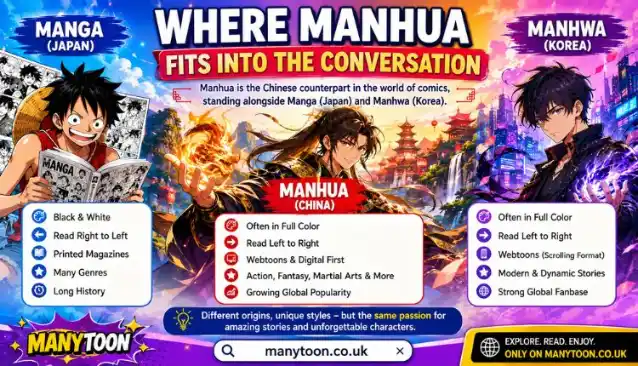
If you keep reading about manga and manhwa long enough, manhua will show up too. Manhua is China’s version of the same tradition, and it’s grown fast alongside the other two, especially in cultivation and xianxia fantasy stories. Manga, manhwa, and manhua are essentially three regional dialects of the same visual language: comics born from a shared history, shaped by different publishing systems and censorship rules.
Some readers treat this as trivia. Others treat it as a genuine point of pride, correcting anyone who calls Solo Leveling a manga (it’s manhwa, adapted from a Korean web novel) or Tales of Demons and Gods a manhwa (it’s manhua). Getting the label right isn’t gatekeeping for its own sake. It affects how you search for a series, which platform hosts it, and whether more chapters are even coming.
Why “Manhwa Manga” Search Interest Keeps Climbing
A few things pushed these terms into the same search queries over the past few years:
- Anime adaptations of manhwa: Solo Leveling’s anime brought millions of manga fans face to face with Korean webtoons for the first time, and many didn’t know the difference going in.
- App algorithms mixing formats: Reading apps rarely separate manga shelves from manhwa shelves. A recommendation feed will happily place a Korean regression story next to a Japanese shonen title with zero context.
- Genre overlap: Isekai (getting transported to another world) and its Korean cousin, the “hunter” or “dungeon” genre, scratch a similar itch. Readers bouncing between the two don’t always register the country switch.
- Aggregator platforms: Sites built to host both formats under one roof, Manhwa Manga rather than one or the other, train readers to think of them as a single category.
That last point matters if you’re choosing where to actually read. Manytoon’s overview of its platform is a decent example of how a mixed-format library gets organized: genre tags, update schedules, and bookmarking so you can track a manga and a manhwa side by side without losing your place in either.
Popular Manhwa and Manga Genres Worth Knowing
If you’re new to either format, genre labels will do more to guide you than country of origin ever will. A few that show up constantly in manhwa manga searches:
Regression and reincarnation stories. A character dies, gets a second chance, and uses future knowledge to change the outcome. Solo Leveling and Reincarnator are the poster children here, and the genre is almost entirely a manhwa specialty.
Isekai and portal fantasy. Ordinary person, different world, usually with a system, stats, or dungeons attached. Popular in both manga (Re: Zero, That Time I Got Reincarnated as a Slime) and manhwa (The Beginning After the End).
Romance fantasy. Heavier on the Korean side, often following a female lead who gets reborn as a villainess or side character and rewrites her fate. The Remarried Empress and Who Made Me a Princess are staples.
Shonen action. Squarely a manga category, built around training arcs, tournaments, and long-running rivalries. Think My Hero Academia or Jujutsu Kaisen.
A Note on Raw Scans and Original-Language Reading
Some readers eventually want to go further and read manhwa in its original, untranslated form, often called manhwa raw. It’s a way to catch new chapters before an official translation lands, and for language learners, it doubles as reading practice in Korean.
Manytoon’s breakdown of manhwa raw covers what the term means and why some readers seek it out, along with the caveats worth knowing before you do: raw scans skip the editing and localization pass a licensed release gets. So names, jokes, and cultural references land differently than in an official version.
How to Start Reading Manhwa and Manga Without Getting Overwhelmed
The libraries are enormous, and that’s exactly the problem for a new reader. A few ways to narrow it down:
- Pick a genre first, not a title: Deciding “I want a slow-burn romance fantasy” gets you further than scrolling a trending list with no filter.
- Check the completion status: Some series run for years with no end in sight. If you hate cliffhangers with no resolution date, filter for completed titles.
- Read a synopsis before the first chapter: Manhwa summaries tend to spoil the premise on purpose (it’s part of the marketing style), which actually helps you decide if the hook is for you.
- Use bookmarking: Once you’re juggling three or four ongoing series, a platform that tracks your last-read chapter saves real time.
- Don’t assume update day: Weekly releases are common but not universal. Some series post twice a week, others go on hiatus without warning.
For general background, see the Wikipedia overview of manga.
FAQs
Is manhwa the same as manga?
No. Manga is Japanese, and manhwa is Korean. They’re related traditions with overlapping genres, but they come from different countries, industries, and (usually) different art and reading conventions.
Why do people say “manhwa manga” as one phrase?
Mostly out of habit built from mixed-format reading apps and genre overlap, not because the two words are interchangeable. Search engines see the combined phrase often enough that it’s become its own informal search term, even though the correct usage keeps them separate.
Is manhwa considered manga in Japan?
No, and this distinction matters to publishers and fans alike. Japan has its own domestic term for Korean comics, and calling a manhwa “manga” in front of a Korean creator or fan community is a quick way to get corrected.
What’s the difference between manhwa and a webtoon?
Manhwa refers to the country of origin (Korea). Webtoon refers to the format: vertical-scroll, mobile-first, usually full color. Most manhwa today are released as webtoons, but the two words describe different things.
Which is bigger right now, manga or manhwa?
Manga still has the larger global market by a wide margin, built on decades of anime adaptations and print sales. Manhwa is the faster-growing segment, driven by webtoon platforms and a wave of recent anime adaptations pulling in new readers.
Where can I read both manga and manhwa in one place?
Aggregator platforms exist specifically for this, hosting both formats with genre filters so you don’t have to jump between separate manga-only and manhwa-only sites. Manytoon is one example built around that mixed library.
Conclusion
“Manhwa manga” isn’t a single format. It’s shorthand for two comic traditions that grew up an ocean apart and now share shelf space on the same apps. Manga gave the world decades of print storytelling and a right-to-left reading habit that still confuses newcomers. Manhwa took the vertical scroll and ran with it, building an entire genre ecosystem around regression arcs and romance fantasy that barely existed twenty years ago.
Knowing the difference isn’t just trivia. It changes how you search for new chapters, which platform actually hosts the series you’re chasing, and whether the story you love is getting an anime adaptation next season or a licensed print release instead. Once you’ve got that sorted, the genre rabbit hole is the fun part.
