

You’ve probably typed it in a text five minutes ago without thinking twice. “Pretty much done.” “I pretty much agree.” It’s one of those phrases English speakers lean on constantly, yet almost nobody stops to ask what it’s actually doing in the sentence. So let’s slow down and look at it properly.
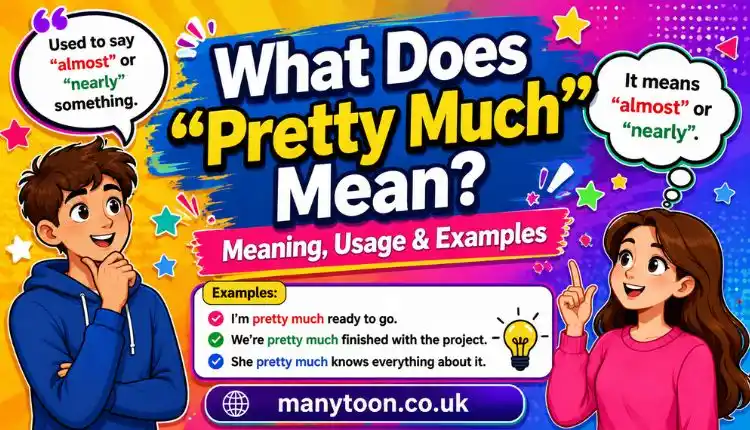
“Pretty much” is an informal adverbial phrase that means almost entirely, for the most part, or essentially. It softens a statement just enough to leave a little room for exception, without making you sound unsure. That’s the whole appeal of it: confidence with a safety net, Visit more.
What “Pretty Much” Actually Means
Break the phrase into its two pieces, and it stops making literal sense. “Pretty” here has nothing to do with appearance, and “much” isn’t quantifying anything on its own. Together, though, they form a fixed expression that native speakers use to mean almost completely or basically.
- “I’m pretty much finished with the report.” → I’m almost finished, maybe one small thing left.
- “That’s pretty much what happened.” → That’s an accurate summary, give or take a detail.
- “He’s pretty much the best player on the team.” → Arguably the best, with little room for debate.
Grammatically, it functions as an adverb phrase, and it usually sits right before the word or clause it’s softening: a verb, an adjective, or a whole statement.
Where the Phrase Comes From
“Pretty” has been used as an intensifier (as in “pretty good” or “pretty tired”) since at least the 16th century, long before it settled into “pretty much.” Linguists trace this use back to the older meaning of “pretty” as “cleverly” or “to a considerable degree,” which drifted over time into a general-purpose hedge word.
Pair it with “much,” and you get a phrase that’s been doing quiet, unglamorous work in everyday speech for well over a century. It never really became formal, and that’s exactly why it’s still so useful in conversation, texting, and casual writing.
How to Use “Pretty Much” in a Sentence
The phrase is flexible enough to slot into almost any topic. Here’s what that looks like across a few different everyday situations.
Talking about food: “Once the sauce reduces for ten minutes, the dish is pretty much ready to serve.” If you’re new to cooking and want a few more forgiving recipes to practice on, the food section has some worth trying.
Talking about health: Doctors will tell you that good health pretty much comes down to sleep, movement, and what you eat, in that order. There’s more on the basics over in the health category.
Talking about work or marketing: “Digital marketing pretty much runs on content and consistency now.” That’s true whether you’re managing a blog or an ad account, and the digital marketing hub breaks down a few of the moving parts.
Talking about online reputation: “Once a bad review goes up, the damage is pretty much done unless you respond fast.” That’s the entire logic behind reputation management, explained in more depth in this piece on what ORM marketing actually involves.
Talking about entertainment: “If you’ve read enough manhwa, you can pretty much guess where the plot twist is going.” Fair warning if you’re browsing the manhwa and webtoon guide, some of these tropes repeat a lot.
Talking about cars: “The engine’s pretty much rebuilt at this point, just waiting on one part.” Anyone who’s spent a weekend under the hood knows that feeling, and there’s plenty more on that over on the automotive page.
Notice the pattern: “pretty much” always sits close to the thing it’s qualifying, and it never needs a comma around it. Drop it in, and the sentence keeps its shape.
“Pretty Much” vs. Similar Words
A handful of phrases do roughly the same job, but they don’t all carry the same tone or land in the same setting. Here’s how they compare.
| Phrase | Meaning | Formality | Example |
| Pretty much | Almost entirely, basically | Informal | “I’m pretty much done.” |
| Almost | Very close to, not quite | Neutral | “I’m almost done.” |
| Essentially | In basic terms, fundamentally | Formal | “The report is essentially complete.” |
| Virtually | Nearly, in all but name | Formal/Neutral | “The task is virtually finished.” |
| Basically | In simple terms, at its core | Informal/Neutral | “It’s basically the same idea.” |
| More or less | Approximately, roughly | Neutral | “That’s more or less accurate.” |
| For the most part | Mostly, in most cases | Neutral/Formal | “For the most part, the plan worked.” |
If you’re writing a cover letter or a report, swap “pretty much” for “essentially” or “for the most part.” If you’re texting a friend, “pretty much” is exactly the right register, and forcing “essentially” into that message would sound stiff.
Is “Pretty Much” Formal or Informal?
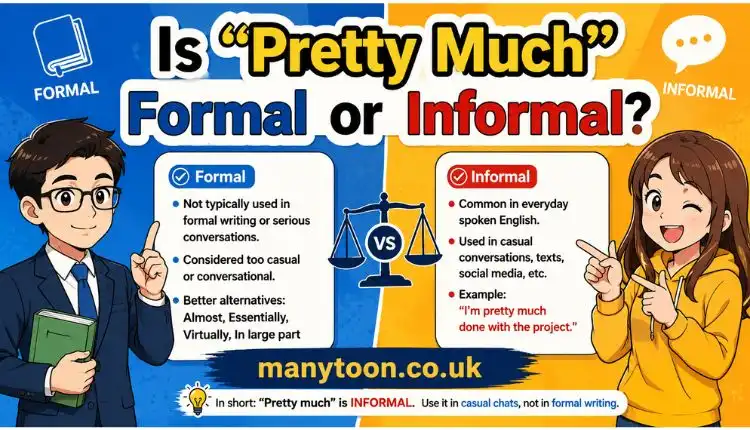
It’s informal, full stop. You’ll hear it constantly in conversation, in podcasts, in casual emails between coworkers who know each other well. You won’t see it in academic papers, legal documents, or anything meant to sound authoritative.
That doesn’t make it sloppy English; it’s a normal, well-established part of spoken and casual written English, the same way “kind of” and “sort of” are. The mistake isn’t using it, it’s using it somewhere the tone doesn’t fit.
Common Mistakes With “Pretty Much”
Using it in formal writing: A dissertation or a client proposal shouldn’t contain “pretty much.” Swap it for “largely,” “essentially,” or “in most respects.”
Overusing it in one paragraph: Like any filler-adjacent phrase, it loses its punch if it shows up three times in five sentences. Vary it with the alternatives from the table above.
Treating it as a precise measurement: “Pretty much” signals approximation on purpose. If you need an exact figure, say the exact figure instead.
Misplacing it in the sentence: It should sit right next to what it’s modifying. “Pretty much I finished the work” reads awkwardly compared to “I pretty much finished the work.”
For general background, see the Wikipedia overview of intensifiers.
FAQs
Is “pretty much” grammatically correct?
Yes. It’s a standard, well-established adverbial phrase in English, though it belongs to informal registers rather than formal writing.
Can you start a sentence with “pretty much”?
You can, and people do it in speech all the time: “Pretty much everyone agreed.” It’s less common at the start of formal written sentences, but it’s not wrong.
What’s a more formal way to say “pretty much”?
“Essentially,” “largely,” “for the most part,” or “virtually” all work well in formal contexts, depending on the exact shade of meaning you need.
Does “pretty much” mean the same as “exactly”?
No. “Exactly” means precisely and completely, with zero room for exception. “Pretty much” leaves a small margin, meaning close to complete or accurate but not guaranteed to be perfect.
Is “pretty much” one word or two?
It’s always written as two separate words: “pretty much.” There’s no hyphenated or single-word version in standard English.
Conclusion
“Pretty much” earns its place in everyday English because it does something useful: it lets you commit to a statement while quietly admitting the world is a little messier than absolutes allow. Save it for conversation, texts, and relaxed writing; reach for “essentially” or “largely” when the occasion calls for something sharper, and you’ll never misuse it again. Small phrase, real function, and now you know exactly (or, well, pretty much exactly) how it works.
