


Hentai is one of the most searched yet frequently misunderstood terms connected with Japanese manga and anime. Outside Japan, people generally use the word to describe illustrated or animated material created for audiences. The term can cover manga, anime, digital comics, webtoons and independent artwork.
However, hentai is not a single genre with one fixed style. It is a broad label applied to oriented media that may include romance, fantasy, comedy, drama or fictional role-playing themes. The format, artwork, and depth of storytelling can vary considerably between creators and platforms.
This guide explains what hentai means, how it relates to manga and anime, the formats readers commonly encounter, and how to explore this type of content responsibly. Readers who are new to the wider website can also begin with the Manytoon Com introduction to understand how its comic and manhwa guides are organised.
What Does Hentai Mean?
In international internet culture, hentai commonly refers to explicit manga, anime or anime-style artwork intended. The word is often used as an umbrella term rather than the name of one particular storytelling category.
The Japanese use of the word is somewhat different. In Japanese, hentai can describe abnormal, unusual, or inappropriate behaviour. It may also be shortened to the letter “H” in casual expressions. The international meaning developed as Japanese animation and comics reached audiences in other countries.
Today, a person searching for hentai might be looking for:
- Manga presented in traditional comic panels
- Animated stories influenced by anime
- Full-colour digital comics
- Mobile-friendly webtoons
- Independent illustrations or short visual stories
- Information about the history of Japanese media
Because the search term is so broad, readers should look beyond the main keyword and check the format, age rating, creator information and content description before opening a title.
Hentai, Manga, Anime and Manhwa: What Is the Difference?
The terms hentai, manga, anime and manhwa are sometimes placed together, but they do not mean the same thing. Manga and manhwa describe comic traditions or publishing formats. Anime refers to animation. Hentai describes the nature of a work when the word is used internationally.
| Term | Main origin | Typical format | Reading or viewing style | Audience |
| Hentai | International use of a Japanese term | Manga, anime, webtoons or artwork | Depends on the format | only |
| Manga | Japan | Printed or digital comics | Often read from right to left | All age groups, depending on rating |
| Anime | Japan | Animated series or films | Video viewing | All age groups, depending on rating |
| Manhwa | South Korea | Printed comics or digital webtoons | Often left to right or vertical scrolling | All age groups, depending on rating |
| Webtoon | South Korea and global digital publishing | Full-colour online comics | Vertical scrolling on mobile devices | Depends on the title and platform |
A manga can be action-based, romantic, comedic or educational without containing material. The same applies to anime and manhwa. Hentai is therefore better understood as an age-restricted content label rather than a replacement word for manga or anime.
Readers interested in the digital format can find a more focused explanation in the Hentai Webtoon guide.
How Hentai Became a Global Search Term
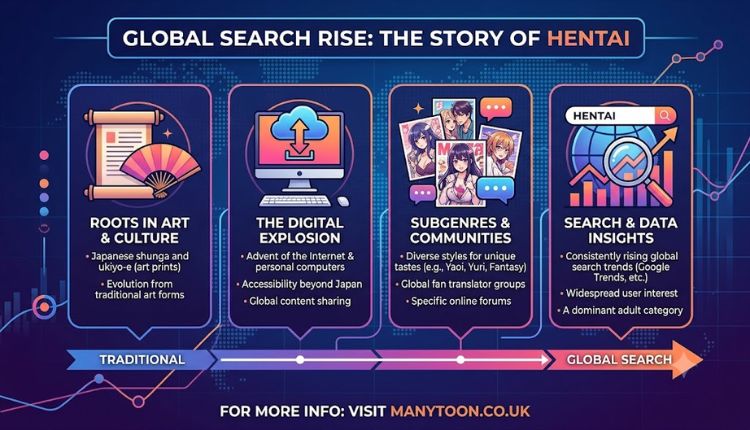
Japanese illustrated storytelling has a long history, but the international use of hentai expanded mainly through home video, fan communities and the internet. As anime and manga became more accessible outside Japan, audiences needed simple labels for different categories of Japanese media, know more click here.
“Hentai” eventually became the widely recognised English-language search term for explicit anime-style content. It appeared in online forums, fan translations, video catalogues and early digital archives. Search engines later reinforced this meaning because websites consistently used the same keyword in their titles and descriptions.
Digital publishing changed the format as well. Oriented illustrations were no longer limited to printed books or recorded animation. Creators could publish short comics, scrolling webtoons, and independent series directly online.
The result is a category that now includes both traditional Japanese-style manga and digital work produced by artists from many countries.
For more background on manga terminology, see Exploring the World of Hemtai Manga, which covers one of the common spelling variations used in online searches.
Common Hentai Formats
People searching for hentai may encounter several types of content. Understanding the format makes it easier to choose material that suits a reader’s preferences while avoiding misleading websites.
Hentai manga
Hentai manga uses comic panels, speech bubbles, and illustrated pages. Some titles are short, self-contained works, while others use multiple chapters to develop characters and a continuing plot.
Traditional manga is commonly monochrome, although digital releases may include colour pages or fully coloured artwork. Readers who prefer longer stories can explore ManyToon’s guide to the best hentai manga.
Hentai anime
Hentai anime presents stories through animation. Episodes may be based on an existing manga, visual novel or original script.
Animation adds voices, music and movement, but episode length and production quality vary. Should check the title’s description, rating and content warnings before viewing it.
Hentai webtoons
Webtoons are designed for vertical scrolling, particularly on smartphones. They commonly use full-colour artwork and release stories one episode at a time.
This format is closely connected with the growth of digital manhwa. Compared with conventional manga pages, webtoons give artists more control over spacing, pauses and the timing of visual reveals.
Manhwa
Manhwa originates from, or is influenced by, Korean comics. It frequently uses the webtoon format, with full-colour panels and mobile-friendly layouts.
The phrase “hentai manhwa” is widely used online, although “manhwa” or “mature manhwa” may be more accurate because hentai is a Japanese word. The Manwha Hentai Comic guide explains how these search terms overlap.
Readers who encounter Indonesian or Malaysian terminology can also consult the guide to Komik Hentai Manhwa.
Independent digital artwork
Some hentai content does not belong to a published manga or animated series. Independent artists may release illustrations, short comics or subscriber-only collections through creator platforms.
Checking the creator’s official account is important. Reuploaded copies may remove credits, lower the image quality or distribute work without permission.
Why Do Read Hentai?
People consume fictional media for different reasons, so there is no single explanation that applies to every reader.
Some are interested in anime-style artwork. Others prefer visual stories that combine mature themes with character development. Privacy and accessibility also affect its popularity because digital material can be viewed on personal devices without purchasing physical publications.
Fantasy is another factor. Illustrated media can present fictional worlds, supernatural settings, and exaggerated situations that would not fit realistic films or conventional romance stories.
For some readers, the story matters as much as the content. A series with consistent characters and an ongoing narrative may create more engagement than a collection of unrelated images.
These preferences remain personal. Should choose material that is legal, consensual in its fictional presentation, and clearly labelled for an appropriate audience.
Hentai Manga Versus Hentai Webtoons
Although both formats use illustrations and dialogue, their reading experiences are noticeably different.
Hentai manga generally follows a page-based structure. The creator arranges several panels on one page and expects the reader to move through them in a particular order. This format works well on larger screens, tablets, and printed books.
Hentai webtoons use one long vertical canvas. Readers scroll down while the creator controls the distance between panels. A large space can slow the scene, while closely positioned panels can make the story feel faster.
Webtoons also tend to use more colour because they are produced for digital distribution. Manga may rely more heavily on line art, screentones, and black-and-white shading.
Neither format is automatically better. The choice depends on whether the reader prefers traditional pages or continuous mobile scrolling.
How to Find Reliable Hentai Platforms
Websites vary widely in quality and safety. Some clearly identify their owners, subscription terms, and content policies. Others use deceptive advertisements, copied material or aggressive pop-ups.
Before using a platform, check the following points:
Clear age restrictions
A responsible website should state that its sections are restricted to people aged 18 or above, or the legal age in the visitor’s country.
Transparent ownership and contact information
Look for an About page, contact details, terms of service and a privacy policy. A site that hides all company information deserves extra caution.
Secure connection
Check that the website uses HTTPS. This does not prove that every piece of content is trustworthy, but it protects information transmitted between the browser and the website.
Understandable payment terms
Paid platforms should state the price, billing period, cancellation process and renewal policy before collecting payment details.
Creator and publisher credits
Reliable platforms identify artists, publishers or copyright owners. Proper credits help readers distinguish official releases from unauthorised copies.
ManyToon has a separate overview of hentai websites and quality considerations for readers comparing different platform types.
Online Privacy and Device Safety
Content searches sometimes lead to websites with intrusive adverts, fake download buttons or misleading browser notifications. Basic security habits can reduce these risks.
Keep the browser and operating system updated. Security updates often fix vulnerabilities that malicious websites try to exploit.
Avoid downloading unknown applications, browser extensions or compressed files. A website should not require unrelated software simply to display an image or comic.
Do not allow browser notifications unless the service is trusted. Notification permission can be misused to deliver repeated advertisements or fraudulent security warnings.
Use a unique password for any subscription account. Reusing the same password across several websites can expose other accounts if one platform suffers a data breach.
Readers should also review cookie controls and privacy settings. Private browsing can prevent local browsing history from being stored in the usual way, but it does not make a person anonymous to websites, internet providers, or network administrators.
Legal and Ethical Considerations
The legal status of illustrations varies between countries. Material that is permitted in one jurisdiction may be restricted in another. Be responsible for understanding the laws that apply where you live.
Never access, download or share content depicting minors. Avoid platforms that use ambiguous age descriptions or try to disguise illegal material with fictional labels.
Copyright also matters. Unauthorised websites may copy and distribute work without compensating the artist. Using official stores, licensed platforms or the creator’s verified page gives more support to the people who made the content.
Should also pay attention to fictional consent, content warnings and personal boundaries. A title can be legal while still containing themes that a particular reader would prefer to avoid.
Responsible viewing means making deliberate choices rather than clicking whatever appears first in search results.
Alternatives to Hentai Content
Some visitors use the keyword hentai when they are actually looking for romance, mature drama or suggestive manga without explicit content. Several adjacent categories may provide a better match.
Mature manhwa often focuses on complicated relationships, workplace drama and psychological conflict. Ecchi manga typically includes suggestive humour or fan service but is less explicit. Seinen and josei titles may explore relationships without being classified as hentai.
Readers looking for broader comic recommendations can visit the Best Manhwa Sites guide. Those interested in free, general-audience Korean comics can also explore the guide to reading manhwa online free.
Checking these alternatives can prevent readers from entering sections when they only want mature storytelling.
Frequently Asked Questions
What is hentai?
Hentai is a term commonly used outside Japan for explicit manga, anime and anime-style digital content intended.
Is hentai the same as anime?
No. Anime is the general term for Japanese animation and includes children’s programmes, comedy, action, romance and many other genres. Hentai refers specifically to explicit material.
Is every manga hentai?
Not necessarily. Some manga deals with relationships, violence or psychological themes without containing explicit material. Age ratings and content descriptions provide a more accurate guide than genre labels alone.
What is the difference between hentai manga and hentai manhwa?
Hentai manga is usually associated with Japanese comic styles. Manhwa comes from Korean comic traditions and commonly uses full-colour vertical webtoon layouts. Online users sometimes mix the terms even though their origins are different.
Are hentai websites legal?
That depends on the content, the website’s licensing practices and the law in the visitor’s country. Should avoid illegal material, confirm local restrictions and use platforms that clearly identify their policies and publishers.
Can hentai websites contain malware?
Some untrustworthy websites use malicious adverts, fake downloads or deceptive redirects. Avoid unknown files, keep devices updated and leave any site that demands suspicious software or permissions.
Is hentai only available as animation?
No. It can appear as manga, digital comics, webtoons, illustrations, visual novels or animation.
How can readers support hentai artists?
Purchase official releases, subscribe through verified creator pages, buy licensed translations, and avoid websites that remove credits or repost paid work without permission.
Conclusion
Hentai is an international label for oriented manga, anime and related illustrated media. Although the keyword is often treated as a single genre, it covers several formats, art styles and approaches to storytelling.
Understanding the differences between manga, anime, manhwa and webtoons helps find the material they are actually searching for. It also makes it easier to identify misleading platforms and avoid content that does not match personal or legal boundaries.
Those who choose to explore hentai should use secure, transparent and lawful sources. Check age ratings, respect copyright, protect personal data, and avoid any platform that fails to maintain clear ethical standards. A careful approach supports creators while providing a safer and more responsible reading experience.
